How thick should a concrete slab be? A practical look at the common residential pours we do across South-East Queensland.
The right slab thickness depends on what's going on top of it. A patio that only ever sees a couple of chairs and a dog has different requirements to a slab that's going to support a brick extension. Here's how the common residential pours stack up.
Patio and alfresco slabs
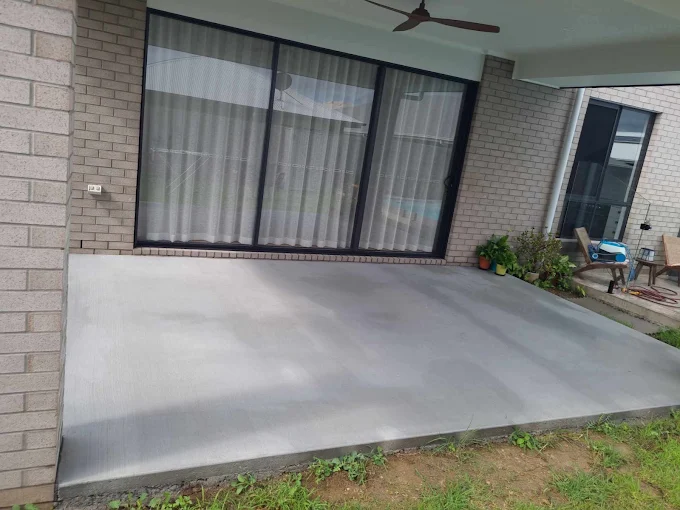
Most domestic patio slabs are poured at 100 mm thick with steel mesh through the middle. That's enough for foot traffic, outdoor furniture and the occasional barbecue. Going thicker only matters if the slab also has to support a roof or a structural load.
Shed and garage pads
Residential shed slabs are usually 100 mm with mesh; garage pads where a car will sit regularly are often poured at 100 to 125 mm with reinforcement sized to suit. Heavier sheds with workshop equipment, hoists or vehicle service pits need an engineered slab.
Driveways
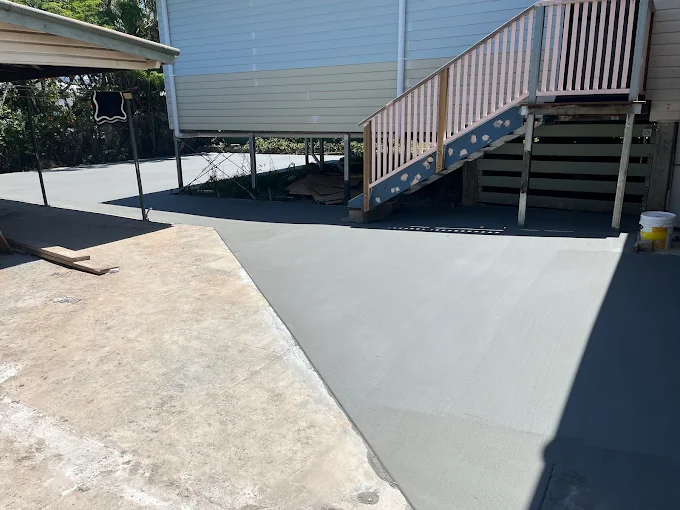
Standard residential driveways are typically 100 mm with mesh. Where the driveway has heavy vehicle access — trailers, work utes loaded up, the occasional truck — we'll often thicken sections or step up the reinforcement.
House extensions and structural slabs
Anything load-bearing should be engineered. House extensions, raft slabs, suspended slabs and anything supporting brickwork all need a structural engineer's design and inspection. We pour to the engineered drawings — that's not a place to guess.
A simple rule of thumb
If something heavy or structural is sitting on it, get it engineered. For everyday domestic patios, sheds and driveways, 100 mm with mesh is the baseline and that's what most quotes are built on.